The Origin of Seven Regulators & Four Shadows
Three hundred and eighteen years before Ptolemy set down his Tetrabiblos — the foundational text of Western astrology — Chinese astronomers had already written the world's oldest verified planetary astrology record.
The document is the Five Planet Divination (五星占), excavated from the Mawangdui Silk Texts in 1973. Dated to approximately 168 BCE, it records the positions of Mercury, Venus, Mars, Jupiter, and Saturn across multiple centuries. Modern ephemeris software confirms these positions. They are not symbolic — they are astronomically verifiable.
This is the origin of Seven Regulators & Four Shadows (七政四餘).
Before Mawangdui: The Archaeological Trail
The Mawangdui Silk Texts (c. 168 BCE) contain the first complete, numerically precise planetary record. But the 28 Lunar Mansion framework that underlies the system is demonstrably older — attested by two earlier layers of archaeological evidence.
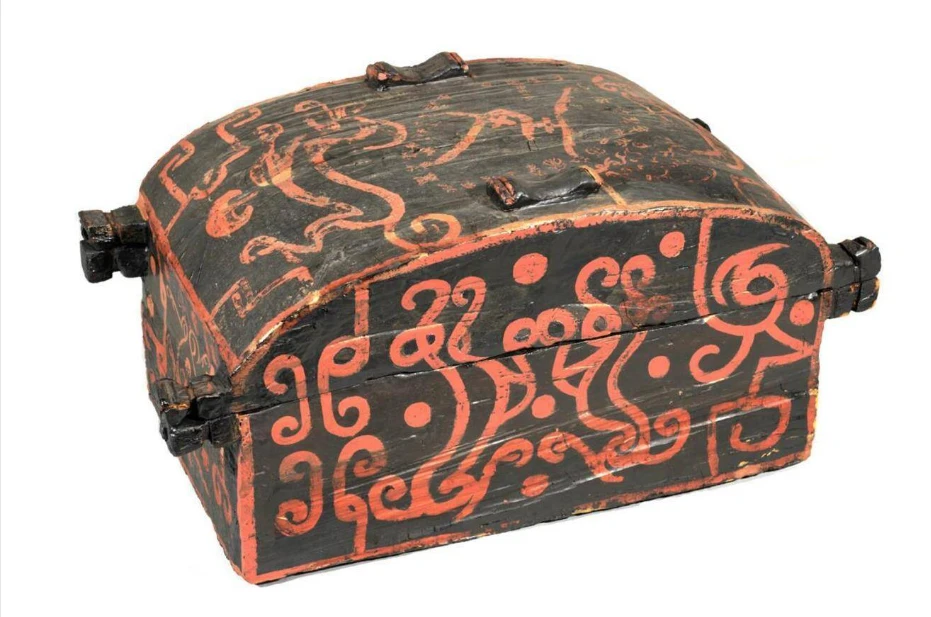
The earliest physical artifact is the lacquer box lid from the Tomb of Marquis Yi of Zeng (曾侯乙墓, c. 433 BCE), excavated in Hubei province. It bears the complete list of all 28 Lunar Mansion names alongside Azure Dragon and White Tiger constellations — the earliest known physical record of the full 28-mansion system. The names are there; the degree measurements are not yet present.
By the Qin dynasty, the Shuihudi bamboo strips (睡虎地秦簡) and Fangmatan bamboo strips (放馬灘秦簡) record the 28 Lunar Mansions in active divination use — auspicious and inauspicious assignments for each mansion. Again, names and judgments, but not yet quantified degree data.
The Mawangdui Evidence: Where Numbers Arrive
The Mawangdui Silk Texts were sealed in a Han dynasty tomb around 168 BCE. Among them, the Five Planet Divination records the orbital cycles of the five visible planets with a precision that matches modern astronomical computation.
This is the critical threshold: not merely that the mansions were named and used, but that planetary positions were recorded with measurable degree data. This is what separates Eastern Classical Astrology from symbolic traditions — every position can be checked against a modern ephemeris. Every claim can be tested.
The lineage, then, runs from 433 BCE (framework established) through the Qin dynasty (divination use) to 168 BCE (first verifiable planetary measurements) — and Ptolemy's Tetrabiblos appears 318 years after that last date, around 150 CE.
The Astronomical Architecture
The Seven Regulators & Four Shadows system uses a dual coordinate framework built for precision.
The first layer is the 28 Lunar Mansions — the equatorial stellar matrix that forms the backbone of the system. In the Modern Mansion System (今宿制) practiced at Goxingtang, mansion boundaries are precession-corrected and verifiable against modern star catalogues. The foundational mansion degrees appear in the Huainanzi (《淮南子·天文訓》, c. 139 BCE) and the Book of Han (《漢書·律曆志》, c. 104 BCE).
The second layer is the Tropical Ecliptic — governing the positions of the Seven Regulators (Sun, Moon, Mercury, Venus, Mars, Jupiter, Saturn) and the Four Shadows: four calculated sensitive points derived from orbital mathematics, with no physical bodies.
Every element of this system can be independently verified against a modern ephemeris.
The Philosophy: Born of the Stars' Resonance
The astronomical precision is inseparable from the system's philosophical foundation.
The Records of the Grand Historian (《史記·天官書》), composed during the Han dynasty, contains the declaration that anchors the entire tradition: 感星而生 — "born of the stars' resonance." Celestial forces do not merely correlate with human life — they are its source.
This is the principle of Stellar Embodiment (星宿化人): the 28 Lunar Mansions are not passive coordinate markers but active cosmological matrices. The natal degree of the Sun (day birth) or Moon (night birth) falls within a specific lunar mansion; that mansion carries a planetary quality; that quality becomes the individual's Stellar Regent (命元星) — the primary axis of the entire natal chart.
The Life Palace (命宮), calculated using True Solar Time and a light-dark convergence algorithm, locates the individual within the daily solar cycle. Unlike the Western Ascendant — which marks the geographic horizon at a moment — the Life Palace identifies the zone where day transitions to night at birth, calibrated to the actual elliptical variance of Earth's orbit.
From Court Astronomy to Cultural DNA
Over the following millennium, the Stellar Embodiment principle moved from the imperial observatory into Chinese culture itself.
The Tang dynasty poet Li Bai was described by his contemporaries as a 謫仙人 — a "celestial exile," an immortal displaced from the stars and temporarily inhabiting human form. Within the worldview shaped by this tradition, an individual soul could carry the energetic signature of a specific stellar origin.
By the Ming dynasty, the principle had been encoded into one of China's foundational literary works. In Water Margin (《水滸傳》), the 108 heroes are the earthly incarnations of 36 Heavenly Spirits and 72 Earthly Fiends — stellar embodiments who descend into human life. A cosmological framework so embedded in civilization that a novelist used it as his narrative architecture.
From the Mawangdui tomb to the imperial court to popular literature: the same principle, sustained across fourteen hundred years.
The Living Tradition
The Seven Regulators & Four Shadows system practiced at Goxingtang preserves the original astronomical precision and applies it to natal chart reading today.
The core calculation chain remains what it was in the Han dynasty sources: planetary positions verified against the ecliptic, lunar mansion placement confirmed against precession-corrected star positions, and the Four Shadows derived from orbital mathematics. What has changed is access to computation — ephemeris software that once required a court of astronomers can now run in seconds.
The Stellar Regent — the single most important indicator in a natal chart — is derived from this same chain: natal degree → lunar mansion → planetary quality → primary interpretive axis.
Astronomically grounded. Historically documented. Verifiable at every step.
Frequently Asked Questions
How old is Seven Regulators & Four Shadows?
Seven Regulators & Four Shadows descends from the Five Planet Divination, whose oldest verifiable record is the Mawangdui Silk Texts (c. 168 BCE). The tradition's astronomical and philosophical framework developed across the Han, Tang, and Ming dynasties over fourteen hundred years.
Does this system predate Western astrology?
The Five Planet Divination from which this system descends appears in the Mawangdui Silk Texts (c. 168 BCE), predating Ptolemy's Tetrabiblos (c. 150 CE) by 318 years. It is the world's oldest verified planetary astrology record.
How is this different from Purple Star Astrology (紫微斗數)?
Purple Star Astrology uses virtual star positions — symbolic markers that do not correspond to actual celestial objects and cannot be verified against a modern ephemeris. Seven Regulators & Four Shadows uses the real-time positions of physical planets and precession-corrected stellar coordinates, independently verifiable against modern astronomical data.
What is the Stellar Regent?
The Stellar Regent (命元星) is the primary axis of a natal chart, derived through the lunar mansion of the natal solar or lunar degree. It represents the individual's primary cosmic source embodiment — the specific stellar matrix through which the soul carries its energetic signature into life.